Routing a Request
Most of the time, you don't route requests by hand. As you process a request, Aeon moves it along for you: the toolbar shows the workflow actions that are valid for the request's current status — Check Out, Place On Hold, Reshelve, In Photoduplication, and so on — and choosing one advances the request to its next queue. Your site can also define routing rules that move requests between queues automatically in the background, with nothing for staff to do.
The Route menu described here is the manual override. Reach for it only when a request needs to step outside that normal flow.
When to route manually
Use the Route menu when a request needs to:
- go to a custom queue for specialized processing,
- skip ahead past a step, or catch up on one it missed, or
- move to another site (on a multi-site server).
If the request is simply moving to its normal next step, use the workflow buttons in the toolbar instead — that's the everyday path.
Before you start
- Manual routing requires the Full level of the Requests permission — a step above the Edit level needed for normal processing. With Edit only, the Route menu still appears in the toolbar, grayed out and unavailable.
- You don't need to lock or "process" the request first — routing works whether or not the request is open for editing. Route is unavailable while another staff member holds the lock on the request.
Route a request to another queue
-
Open the request.
-
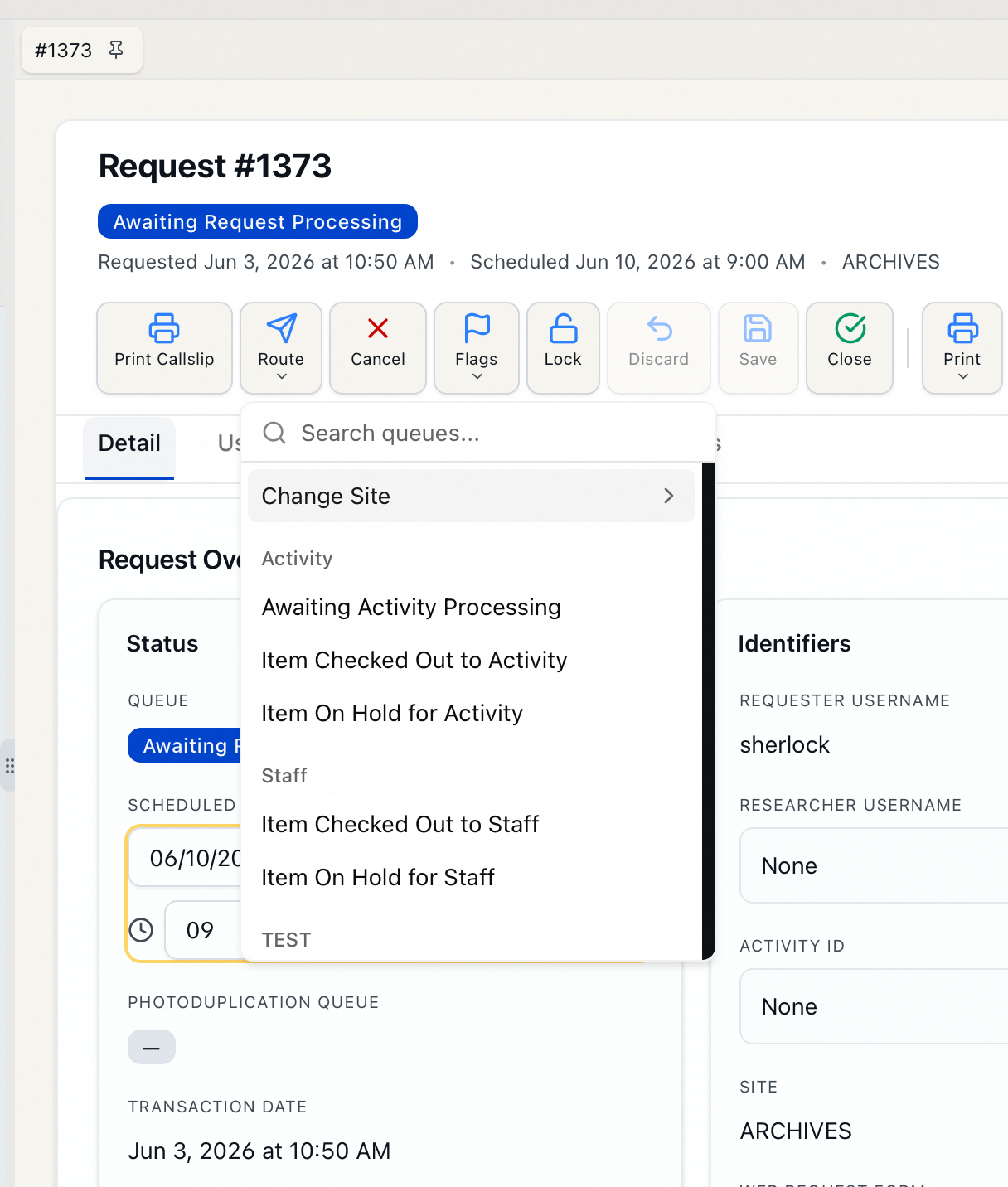
In the toolbar, click Route (the paper-plane button).
-
Choose a destination. The menu lists every active queue of the request's type — including queues that are not its normal next step, which is what makes this the manual override. Queues that belong to a menu group sit behind the group's name: click the group to drill in, then click its name at the top to come back. Queues with no menu group are listed directly, after the groups.
-
In the Confirm Status Change dialog — "Are you sure you want to route request #12345 to …?" — click Continue.
-
The request moves to the chosen queue and your lists refresh. Aeon then closes the request and takes you back to where you opened it from. A pinned request stays open.
To find a queue by name, type in the Search queues... box at the top of the menu. Search reaches across every group at once and shows each match with its group name beneath it, so a queue is findable no matter which group holds it. Use the arrow keys and Enter to select.
When photoduplication has been initialized on a request, a second menu, Route Photodup, appears beside Route. It works the same way and lists the photoduplication queues.
Route from the command palette
The command palette routes a request without the toolbar:
- Open the request.
- Press
Ctrl+K, then type>to list the workflow actions. - Choose Route to Queue.
- Search for the destination — the box reads "Search for a queue to route this request" — and select it.
- Confirm in the same Confirm Status Change dialog.
The palette needs the same Full level of the Requests permission, and a request has to be open for it to act on.
Route a request to another site
On a multi-site server, the Route menu can also move a request to a different site. Change Site sits at the top of the Route menu. It appears only on a shared server, and only on Route — never on Route Photodup.
- Open the request and click Route.
- Choose Change Site, then pick the destination site. The site list has its own Search sites... box. (Your current site is marked (current) and can't be selected.)
- If you have unsaved edits, Aeon asks Save Changes Before Routing? — choose Save & Route, Discard & Route, or Cancel.
- In the Confirm Site Change dialog, click Continue.
- The request moves to the other site and leaves your current site's queues. If it's a site you don't have access to, you won't be able to reopen it.
Route several requests at once
- In a queue, select requests with the checkboxes. A selection bar appears at the bottom of the screen.
- Click Route in the selection bar and choose a destination queue.
- In the Route Requests dialog — "Are you sure you want to route 8 requests to …?" — click Route.
- When the whole batch routes successfully, a status message reads "Routed 8 requests to …". If any request fails, a results dialog opens instead: it gives the number that succeeded and lists each failure with its reason, so you can follow up.
What happens behind the scenes
Manual routing sets the request's status to the destination queue. Aeon records the move twice: a History entry that reads "Status changed to" followed by the destination queue's name, and a row on the Tracking tab. Both carry your username and the time of the change.
Aeon then applies any custom routing your site has configured for that move. At most one routing rule is applied to a request, so a rule that lands it in a new queue does not set off a second rule from there.
Routing to Item Reshelved is the one move that carries on by itself: Aeon takes the request straight on to Request Finished.
Each later move is treated the same way, so the request keeps picking up one matching rule at a time as it continues through the workflow.